
Review: A Taste Of Magic/A Whisper Of Curses
Review by Christopher G. Nuttall
A Taste Of Magic/A Whisper Of Curses
(Park Row Magic I And II)
-J. Elle
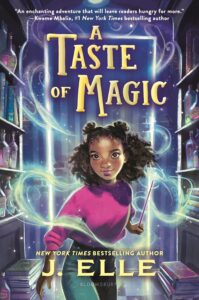
There is a magical community living beside our own, hidden in the shadows. If you think that sounds familiar, you’re probably right. A Taste Of Magic and its sequel draw heavily on the concept laid down by Harry Potter, while adding a certain taste of their own. There is not one school, but dozens: each one tied to a specific community. This mimics American public education to a very great extent: the richer communities have better schools, while the poorer ones have to struggle to find the funding they need to support their students. There is a greater danger here in that some of those schools could be shut down by the magical government and, if they are, their students will not be relocated but have their minds wiped of magic.
Kyana Turner, a young black girl in America, discovers that she is a magician from a long line of magicians (for some reason, the gift sometimes skips a generation: her grandmother has magic, her mother does not) and therefore she must attend mandatory lessons every Saturday at Park Row Magick Academy, the magic school hidden in the back of her local beauty shop. This creates a string of problems both mundane and magical: she must keep the secret of magic from her best (but unmagical) friend, which places immense strain on their relationship, while she makes a deadly mistake that unleashes chaos and threatens to get Park Row Magick Academy shut down. She is forced to take a desperate risk to save her school.
This is not the end of her adventures. In A Whisper Of Curses, Kyana and her (magical) friends attend a summer camp for magicians, a chance to rub shoulders with magicians from all walks of life and meet famous adults who have carved out a reputation for themselves. But the camp soon cut off from the outside world and they find themselves struggling to survive against a threat that strikes at the very root of magic itself.
It is difficult to say which reading level these books are aimed at. On one hand, it is set in a middle school, the characters are in their early teens at most, and many of their problems are the sort that plague such characters. There is no sex, little violence, and most of the early opponents are not as adversarial as Kyana assumed. On the other, the opponent in the second book is much more serious and the plotline touches upon far more adult matters, although at one remove, such as slavery. I can’t tell if the author was making a point or merely using a convenient plotline. I cannot go into too many details because it would be a spoiler, but the enemy’s plot seems a little unrealistic for the former. But it is a fantasy book.
Kyana herself is a very likeable character, with a family that has its issues but is genuinely loving, and most of the problems she faces are ones that make you feel sorry for her. Her love for baking shines through the pages and is appropriate, very much so, that baking helps her solve the problem of the first book. The trouble she faces with hiding the truth about magic from her best friend, which means she cannot attend her friend’s birthday party, is an adolescent problem but she is an adolescent. The struggles of integrating into a new community, her growing love for magic and her desperation to save it … all work to breathe life into her character. It is often harder to make such a character’s relationship with her family work, but the author pulls it off very well.
The world itself is a little vaguer, at least partly because Kyana only ever sees a very small part of it (at least until the second book), but the worldbuilding is generally very good. The author draws on African and African-American traditions to flavour her work, perhaps not as noticeably as The Marvellers or Blood at the Root, yet this works in her favour. Kyana is still a diverse character, but the book does not rely on diversity and is all the stronger for it. A certain element of classism, rather than outright racism, does exist within the magical community: it is oddly refreshing to see this acknowledged, rather than ignored or smeared as racism. It also leads to a point in which a character can back down gracefully, rather than be pushed into a position where they must double down or surrender.
And I will admit it – I loved the baking sections. I love baking myself and is always nice when a character shares an interest with you, particularly one that can be worked neatly into the plot.
Overall, A Taste Of Magic and its sequel are generally very good reads. They have more in common with The Worst Witch than Harry Potter, lacking any sense of a long-term threat such as Voldemort or overarching story arc that continues through several books. The characters are young adolescents and should be treated as such, with the concerns of young adolescents. They do lack the complexity of more complex multi-book series, but that is no bad thing. I recommend them to children and young teens.
And yes, I am looking forward to book three.
Amazon Affiliate Links in Use
Leave a comment