The Last Hope School for Magical Delinquents Review
by Christopher G. Nuttall
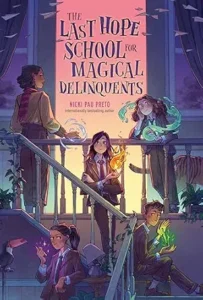
Book 1 – The Last Hope School for Magical Delinquents
Book 2 – The Forbidden Room
-Nicki Pau Preto
It is difficult, in this day and age, to come up with something wholly new for the magic school genre. It is not just Harry Potter, as tempting as it is to blame everything on Rowling overshadowing many other authors, but the sheer volume of books, fan fictions, and everything else that followed in Rowling’s wake, entered into dialogue with her, or even enjoyed a resurgence after the completion of the Harry Potter series sent readers looking for newer and/or better books in the genre. The building blocks of such books are almost always present, from the stories taking place in boarding schools to strict/sadist teachers, dark lords, and other troops that may not have originated with Harry Potter but were certainly made famous once again by Rowling’s success.
In a world where magicl people and muggles coexist uneasily, under the terms of the treaty designed to prevent war between the two communities, a young girl called Lavinia “Vin” Lucas has a problem. Her magical abilities are out of control, she’s been expelled from more schools than she’s had hot dinners and her parents prefer to spend their time studying dung beetles than raising their daughter. After she is summarily expelled from her latest school, she is told that she is going to the Last Hope School, a school for children who have unusual magic and/or delinquent tendencies. If she flunks out of this school, it will be the end.
Thankfully, Vin discovers that the Last Hope School is nowhere near as bad as its reputation, although there are secrets aplenty. She makes friends, discovers that she has a talent which is potentially very dangerous (and connected to one of the school’s secrets), and finds herself fighting to defend the school when it is attacked by both within and without.
There is very little new here, but it is very well presented. Vin is an engaging, likeable character, one who we can feel for and understand even when she makes mistakes (and she does). Her friends are well drawn enough to make me feel a degree of yearning for what an introvert like myself wants – friends who reach out to me – and was yet summarily denied as a child. The headmistress is, again, an understandable adult, as are her staff; the secrets we briefly glimpse seem ominous at first, but they are nowhere near as nasty as one might assume.
In a way, the headmistress is in fact a secondary protagonist, although the book are largely from Vin’s point of view. She is sweet and friendly, and understanding, very much as Dumbledore tries to portray himself, but she lacks both Dumbledore’s darker side and his sheer bloody carelessness. Her past does overshadow the books to some degree, and is more than just a red herring; the headmistress tries, unlike many others, to learn from her mistakes. She is also far more supportive to her staff than Dumbledore, with much better results.
On a wider field, the book has something to say about the treatment of those who do not fit in. Vin does not receive the training she needs until she comes to Last Hope (for various reasons, which I cannot disclose without spoiling everything, this is not wholly the fault of her previous schools). Sometimes, this is represented through officious bureaucracy; sometimes, this is represented by the failings of both Vin’s parents and the book villain’s parents and family. It points out, repeatedly, that students who are excluded and/or denied the education and support they need tend to turn feral, lashing out at the society that attacked them first. The old proverb – the child who is not embraced by the village will burn it down to feel its warmth – is certainly demonstrated here.
The books are aimed at young teenagers, and share many of their weaknesses. The bad guy in the first book is obvious if you look at it through adult eyes, the red herring in the second is a little too obvious before being revealed as such. I guessed the identity of the ultimate villain before he showed himself, although the characters in the book have good reason for assuming the villain in question is dead. Many of the problems could have been resolved with a proper conversation, although the author does work hard to make it clear that such conversations are simply not possible under the circumstances. That said, they are aimed at younger readers. They do not have to be convoluted as many more adult plots.
There are also fairly clean. There are no mentions of sex or anything else along those lines, save for a single moment when Vin is teased for walking out with a male friend. The school bully is a very tame beast indeed, easily ignored, and most of the unpleasantness is centred around the bad guy. This is perhaps fortunate as many of the students have talents that – in the hands of a writer writing for older people – offer a great deal of power perversion potential. It does brush upon some elements of grooming, as the bad guys try to lure Vin into using her powers with bad intentions, but nothing too major.
Overall, in case it isn’t clear, I enjoyed these books. I would recommend them for ten year old children and upwards.
See The Last Hope School for Magical Delinquents on Amazon today!
Amazon associate links in use
Leave a comment